Company news
Pharmacies Transformed into Health Hubs: The Driving Force Behind Service Upgrades Driven Touch Screen Telehealth Self-service Healthcare Kiosk
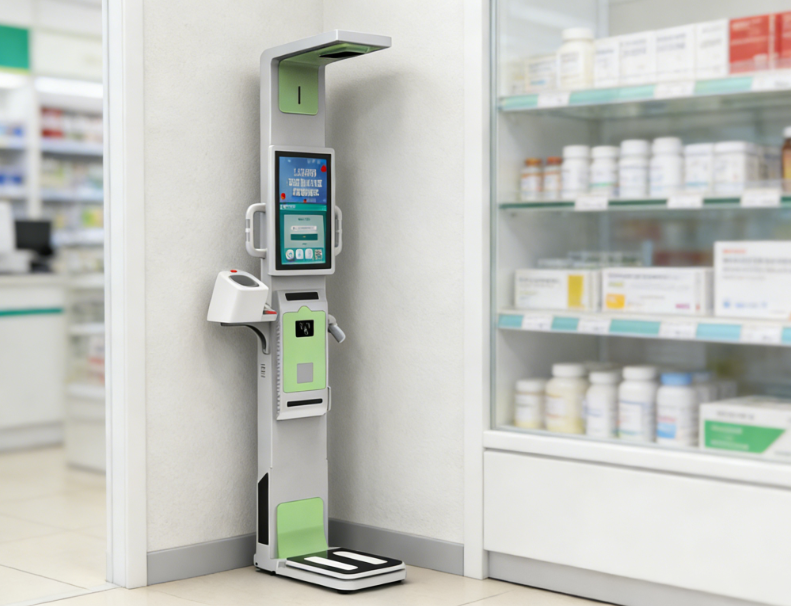
In today's increasingly competitive pharmaceutical retail industry, pharmacies are no longer simply places to sell medicines, but are gradually becoming important nodes in community health services. The introduction of Telehealth Self-service Healthcare Kiosk is driving pharmacies to transform from "selling medicine" to "health management," providing consumers with convenient and comprehensive health services. As a core device connecting prevention, detection, and intervention, Telehealth Self-service Healthcare Kiosks are reshaping the service ecosystem of pharmacies and becoming key to enhancing customer loyalty and store competitiveness.
The Telehealth Self-service Healthcare Kiosk acts as a "mini health check-up center" within the pharmacy setting. This device integrates over 20 testing functions, including height and weight, blood pressure, blood sugar, blood oxygen, electrocardiogram, and body composition analysis, allowing consumers to complete a basic health check-up right at the pharmacy. Unlike the complex procedures in hospitals, the kiosk uses touchscreen operation and voice guidance, enabling fully self-service completion and generating a health report containing data such as BMI, body fat percentage, and blood pressure trends within 5 minutes. This "instant results" experience makes pharmacies the preferred location for community residents' daily health monitoring.
In the field of chronic disease management, the Telehealth Self-service Healthcare Kiosk plays an irreplaceable role. Pharmacies use the device to establish dynamic health records for patients with hypertension and diabetes, regularly monitoring data and synchronizing it to the system. Pharmacists can adjust medication recommendations based on the reports. For example, a diabetic patient can use the kiosk weekly to test blood sugar and glycated hemoglobin; the data is uploaded to the cloud in real time, and doctors can remotely review it and provide medication guidance through the pharmacy, forming a closed-loop service of "detection-intervention-tracking." This model not only improves patient compliance but also makes pharmacies an important part of chronic disease management.
Telehealth Self-service Healthcare Kiosks are also a powerful tool for pharmacies to attract customers and offer value-added services. Many chain pharmacies have launched "free physical examinations + health consultations" programs. After completing the test using the kiosks, consumers can receive a one-on-one report interpretation from a pharmacist. The devices support Traditional Chinese Medicine (TCM) constitution identification, recommending health-preserving teas or TCM conditioning plans based on the test data, thus boosting sales of TCM decoction pieces and health foods. Data from one chain pharmacy shows that after introducing the Telehealth Self-service Healthcare Kiosks, store traffic increased by 30%, and non-pharmaceutical sales increased by 25%, fully validating the commercial value of the devices.
For the elderly and those in a sub-healthy state, Telehealth Self-service Healthcare Kiosks offer personalized health management solutions. The built-in functions of bone density testing and TCM nine-type constitution identification meet the health needs of middle-aged and elderly people. Pharmacies can establish long-term health records for elderly customers, regularly monitoring data changes through the kiosks and providing timely warnings of osteoporosis, cardiovascular risks, and other problems. Simultaneously, the devices support data printing and mobile phone scanning for saving, allowing children to remotely monitor their parents' health and addressing the pain point of health monitoring for "empty nest" elderly.
The intelligent and data-driven features of the Telehealth Self-service Healthcare Kiosk lay the foundation for pharmacies to connect with the regional healthcare system. The device supports a standard network cable interface, allowing it to interface with community health service centers and hospital HIS systems, enabling interconnected health data. When a consumer uses the Telehealth Self-service Healthcare Kiosk at a pharmacy and detects abnormal indicators, the data can be directly pushed to their family doctor. The doctor can then schedule further diagnosis and treatment through the pharmacy, forming a collaborative mechanism of "grassroots screening - tiered medical treatment." This model not only improves the efficiency of medical resource utilization but also makes pharmacies a "frontline" in the tiered medical treatment system.
Categories
Latest News
- Integrated Health Machine: Reshaping the Smart Service Ecosystem of TCM Wellness Centers
- Integrated Health Management Kiosk: The Core Engine for Pharmacy Transformation into Smart Health Services
- Blood Bank Self-Check-In Healthcare Medical Kiosks: Innovative Practices and Core Values of Basic Screening
- A New Line of Defense for Campus Health: The Value and Advantages of the Integrated Health Kiosk
- AI Evaluation Self Service Tele-Health & Tele-Medicine Health Kiosk: An Innovative Engine for Insurance Company Marketing and Member Services
Contact Us
Company: Shenzhen Huasheng Medical Technology Co., Ltd.Contact: Miss Wang
Tel: +86 159 8911 4474
WhatsApp 1: +86 177 2472 6642
WhatsApp 2: +86 198 6570 7933
Email: wincywang@hsyil.com
Address: Room 406, Danfeng Technology Building, Building 2, Chaguang Village Industrial Park, Shuguang Community, Xili Street, Nanshan District, Shenzhen
 Tel:
Tel: